
See how Vigience Overcast enables Ergon to unify SAP S/4HANA and a greenfield Salesforce org during a critical migration for one real-time view of customers.
Ergon Selects Vigience to Unify SAP S/4HANA and Salesforce During Mission-Critical Migration
30
Data connections live in 6-8 months during active S/4HANA migration
200
Sales users operate entirely in Salesforce with zero SAP logins
5
Developers with zero SAP knowledge onboarded in days rather than weeks or months
Industry
Specialty Oil Refining & Distribution (base oils, asphalts, emulsions).
Use Case
Customer 360 Integration, Material Master Sync, Order Management, and SAP Datasphere Integration.
Short Customer Portrait
Ergon, Inc. is a privately held specialty oil refiner headquartered in Jackson, Mississippi. Founded in 1954 by Leslie Lampton with a single truck, the company has grown into a multinational operation with refineries in Mississippi and Virginia. Unlike major integrated oil companies, Ergon focuses on niche refined products such as base oils and asphalts used in Formula 1 tires, highway asphalt, plastics, and industrial applications across four continents. The company operates with approximately 500 Salesforce users across Europe, North America, South America, and Asia.
www.ergon.com
System Landscape
“SAP used to be this black box for us. We’d have to ask somebody, ‘Hey, can you check this SAP API? Can you look into this OData service to get us some data?’ It created communication barriers between our Salesforce and SAP teams.”

Jack Mazza
Development Manager at Ergon
Trapped Between Two Systems
Over seven decades, Ergon has grown from a single truck into a specialty oil refiner with operations across four continents. Its products don’t end up at gas stations; they are used in Formula 1 tires, highway asphalt, plastics, and industrial applications around the world. Today, Ergon runs refineries in Mississippi and Virginia, with sales teams operating across Europe, North America, South America, and Asia.
The company has run on SAP for over 25 years. When the decision came to migrate from SAP ECC to S/4HANA and build a new Salesforce org from scratch, both projects running in parallel, the integration piece couldn’t wait.
Without that view, even a basic management question could become unexpectedly difficult. What is happening with customers in the United States? How is business developing in Mexico? What do the SAP figures show?
For Jack Mazza, Salesforce Development Manager at Ergon, the challenge went deeper than connecting two systems. Jack’s team needed to break down a 25-year-old data silo while executing the company’s most critical IT transformation in decades. To get there, they were looking for autonomy to do it, without the need to rely on intermediaries for every data question. Ergon had already adopted Salesforce, but in a multi-org structure with no connection to SAP. Sales depended on manual handoffs from SAP colleagues to get the data they needed, which slowed execution and made reliable business steering difficult.
“SAP used to be this black box for us. We’d have to ask somebody, ‘Hey, can you check this SAP API? Can you look into this OData service to get us some data?’ It created communication barriers between our Salesforce and SAP teams.” Jack Mazza, Development Manager at Ergon.
Ergon’s integration challenge matched the complexity of its business. Sales teams across Europe, Asia, and South America manage complex product specifications (viscosities, refinery codes, pricing tied to volatile crude markets). Contracts created in Salesforce had no connection to SAP until someone manually bridged the gap, and pricing questions always meant going through an SAP specialist first.
Managing this process across 500 Salesforce users was not sustainable, particularly during the migration of 25 years of SAP ECC customizations to S/4HANA. Ergon chose to focus the first phase on the 200 sales users who depended on SAP data daily.
Three Transformations at Once
Integration was only part of the challenge. Ergon needed to execute three major transformations simultaneously:
1. SAP ECC → S/4HANA Migration: Moving decades of custom ABAP code and legacy workflows into a clean-core S/4HANA architecture.
2. Greenfield Salesforce Deployment: Building a modern CRM from scratch to replace legacy systems across multiple regions.
3. Unifying Two Isolated Data Worlds: SAP held the golden records: account hierarchies (sold-to/ship-to relationships), product master data (including technical specifications critical for refinery operations), pricing, credit limits. But for Jack’s team, SAP data was out of reach without asking someone else first. Jack’s team had no SAP expertise.
All three transformations depended on the same thing: bidirectional, real-time data flow between SAP and Salesforce.
For a company managing sales organizations across continents with complex product hierarchies, solving this became the top priority.
The Solution: Integration That Lives Inside Salesforce
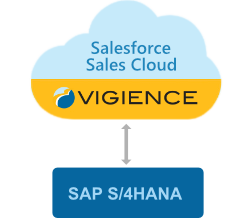
When Ergon partnered with Vigience (working alongside implementation partner Coastal Cloud), they found the architecture they needed: Vigience Overcast operates as a managed package within Salesforce, connecting directly to SAP S/4HANA.
“We’re using standard SAP OData APIs to integrate into Salesforce. We’re keeping our clean core philosophy as much as we can while also integrating back and forth,” Jack explained.
For Ergon, three things changed immediately:
- No new servers to manage. Overcast runs inside Salesforce’s existing environment with no separate infrastructure to install, back up, or monitor.
- Clean-core enabled. Because Overcast integrates exclusively through SAP-standard OData APIs, Ergon was able to maintain a strict clean‑core approach throughout the migration, something alternative iPaaS tools could not support.
- Future-proof for S/4HANA. Standard connections adapt automatically when SAP introduces architectural changes with no custom code rewrites required.
- The autonomy Jack’s team had been looking for. A built-in data explorer let Jack’s Java developers query SAP OData services directly. No more waiting for an SAP specialist to look into an API on their behalf.
“Now we have a direct connection in, and we can query directly against any OData service if we need to. We can better understand what we’re building and communicate with our SAP team on the same level.”
The Implementation Process
Ergon ran the implementation with their internal development staff alongside Coastal Cloud. Vigience’s CTO, a seasoned SAP specialist, worked directly with Jack’s team during the ramp-up phase, bridging the gap between Salesforce development and SAP architecture. For Jack’s team, this hands-on support accelerated a process that would have taken significantly longer otherwise.
The Results
Ergon deployed Overcast across 30 data connections spanning customer accounts, product catalogs, order processing, credit checks, and document management.
1. Sales Teams Got What They Needed – Without Leaving Salesforce
When a sales manager opens a customer record today, they no longer need to ask anyone for context. Credit limits, refinery specifications, pricing conditions, inventory availability, it’s all there, sourced from SAP, updated in real time.
“We use the out-of-the-box Overcast business processes, and we’ve modified them slightly,” Jack explained. “That’s what’s been nice about Overcast, we’ve had the ability to add any additional mappings or logic when it comes to certain codes coming out of SAP.”
The workflow now runs like this:
Sales rep creates contract in Salesforce → System writes it to SAP → SAP generates orders/invoices → Status updates appear back in Salesforce in real-time.
“We’re sending plenty of data to SAP including accounts or contracts. So it’s a relationship that goes both ways.”
Unlike batch processes or overnight data dumps, Ergon’s integration runs live. SAP remains the backbone and system of record, while sales teams get a unified workspace.
2. Developers Who Knew Nothing About SAP Became Self-Sufficient
“I came from a very traditional software developer background, Java full-stack. I knew nothing about SAP. Now, with Vigience Overcast, I’ve been able to learn a lot about how SAP works, and I can start to speak on the same level as our SAP team.”
When pricing looked wrong, developers could now trace the issue back to SAP themselves. No ticket, no waiting for an SAP specialist. This gives the team the technical depth when needed, while remaining easy for developers without SAP experience.
The Overcast tooling like the Component Builder meant the team could build and modify integrations without deep SAP knowledge. When a new SAP field needs to surface in Salesforce, it’s a drag-and-drop mapping change.
The Onboarding Velocity: “We’ve had 4 or 5 different developers come in very quickly, get up to speed, and use Overcast. That’s been a great benefit instead of doing our own custom solution.”
3. Multinational Operations Became Manageable
Ergon operates across Europe, North America, South America, and Asia, each with different sales structures, pricing rules, and product catalogs. The integration recreates SAP’s regional hierarchies inside Salesforce, so each user sees what’s relevant to their territory.
“Ergon’s a multinational company. We have people that sell all over the world. We’re able to kind of recreate that hierarchy and structure inside Salesforce with this Overcast integration.”
What’s Next
With the core integration live, Ergon is already exploring the next phase. Jack’s team is evaluating Vigience’s Revenue Cloud integration for one of Ergon’s asphalt sealant companies, where a more stable price book makes it a strong fit for revenue lifecycle management.
They’re also looking at AI-powered purchase order scanning, uploading a PO as a PDF and having it automatically converted into a sales order in SAP.
The Recommendation
Jack pointed to three factors that made the partnership work:
- Direct influence on product development.“It felt like we had a direct connection into how the product was being developed. What we did directly influenced how the product direction moved, and I think we got a better product out of it for our use case.”
- Responsive technical support.Vigience experts worked directly with Ergon’s team at the architectural level. Issues were resolved within days.
- Low barrier to productivity. Four to five developers with no SAP experience onboarded and started building integrations within days.
“For our sales users, I don’t think they will need to touch SAP at all going forward. They can do all their work in Salesforce, manage the CRM piece, submit their contracts, and those get fulfilled and ordered without ever going into SAP. That’s a big step for us.”
The Vigience Applications Powering Ergon’s Success
Ergon standardized on a stack that keeps SAP as the system of record and makes Salesforce the system of engagement for its sales teams:
Link to: applications > solutions > SAP-integrated customer 360SAP-integrated
SAP-integrated
Customer 360
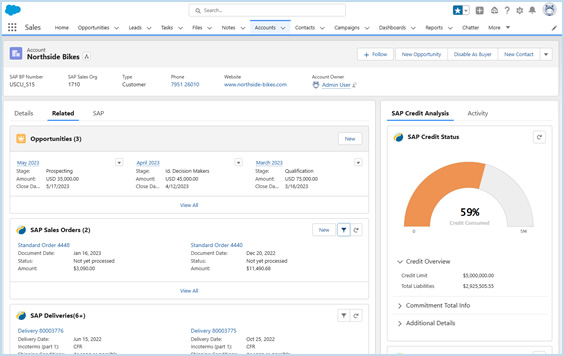
A complete 360° customer view with 24/7 self-service access to orders, invoices, and credit status.
Link to: applications > solutions > SAP-integrated order managementSAP-integrated
SAP-integrated
Order Management
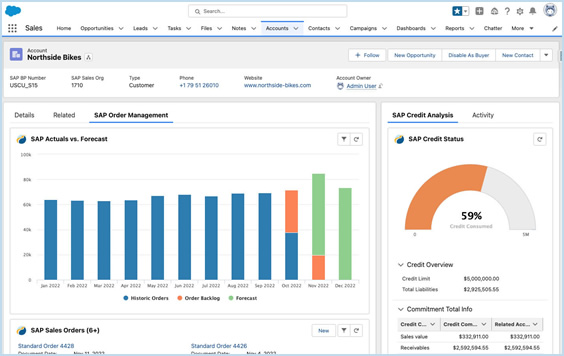
Increased on-time delivery and reduced processing costs through real-time order validation that eliminates double-entry.
Direct Contact
+1 (415) 226-9867
Vigience, Inc.
WATCH THE OVERCAST TEASER VIDEO
Social Media Channels


Compliance Certifications
Vigience Overcast is SAP certified
