
Böttcher Eliminates Manual Order Entry by Connecting SAP and Salesforce with Vigience Overcast

Industry
B2B Hardware Manufacturing (coating of rotationally symmetrical bodies)
Use Case
Customer 360 and Order Management, BI integration & B2B Commerce Solution
Short Customer Portrait
Felix Böttcher GmbH & Co. KG, an owner-managed family business headquartered in Cologne, Germany. It is the world market leader for coating of rotationally symmetrical bodies as used mostly in the printing industry. Around 60% of all printing machines built worldwide are supplied with roller coatings from Böttcher.
The company is considered a hidden champion with over 2’000 employees.
www.boettcher.de
System Landscape
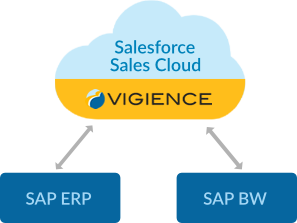
“IT never likes interfaces because they are complicated and not reliable. With Vigience, you just use it and that’s fine.”

Clemens Schmid
CIO, Böttcher GmbH
The Painful Reality of the “Old Way”
For Andreas Zemla, a 20-year Böttcher veteran who became the company’s Salesforce Administrator, the friction was real. Every time a sales manager needed SAP figures – prices, turnover, customer details – they had to pick up the phone or send an email to inside sales and wait.
“In the past, they didn’t have any access to the SAP figures, prices, turnover and so on. Every time they would like to know something about their customers, they had to talk to somebody in our inside sales team to grab the phone or write an e-mail.”
Picture the scene: A sales manager in the US receives an urgent customer inquiry about pricing and availability. Instead of providing a quick answer to the customer, they must interrupt a colleague with access to SAP, wait for a response, and then relay outdated information back to the customer. Multiply this by 300 salespeople across three continents, and the inefficiency becomes staggering.
The Need for Structured Information
Beyond access issues, information was becoming harder to track and structure. As Clemens Schmid, who has led Böttcher’s IT operations for 25 years, described:
“In the past we had a lot of information floating around, but none of it was structured. Salespeople send it out by mail, an Excel sheet or a telephone call, so the information was basically lost.”
For a company serving 60% of the world’s printing machines, this highlighted a clear priority: improving how customer information was captured, structured, and shared across teams.
The US Market Breaking Point
In the United States, the problem reached a critical point. Inside sales representatives had become human middleware – manually transferring order information from customer emails into SAP. Every keystroke introduced error risk. Every minute spent on data entry was a minute stolen from customer engagement.
The Administration Burden
When Böttcher’s board finally authorized Salesforce as their CRM, Schmid’s team evaluated three to four integration platforms to bridge the SAP-Salesforce divide. The evaluation criteria were clear: minimize IT administration overhead.
“The technical overhead that comes with other solutions, administration effort, backups, to be able to check whether the systems are up-to-date and so on… That’s something which you would like to avoid,” explains Schmid.
Traditional integration platforms – whether middleware, ESBs, or custom-built solutions – demanded dedicated technical resources, specialized programming skills, separate backup systems, and constant monitoring. For an IT leader already managing SAP as the company’s backbone, adding another complex system wasn’t the right fit for Böttcher’s requirements.
How Does Vigience Overcast Deliver Native SAP Integration for Salesforce?
When Böttcher contacted Vigience, they discovered an architecture designed to minimize IT overhead. Vigience Overcast operates as a native Salesforce application that connects directly to SAP – no separate integration servers, no additional infrastructure to maintain. “With Vigience, you just use it and that’s fine,” explains Schmid. From an IT administration perspective, this was exactly what Böttcher needed. The integration runs without requiring specialized programming skills, separate backup systems, or constant monitoring. Setup requires only backend login credentials – no dedicated programmers needed. For Andreas Zemla, who manages the Salesforce-SAP integration from the business side, Overcast’s flow functionality made it accessible. He uses flows to call real-time SAP scenarios, retrieve data, process it, and create Salesforce records – all without technical coding.
Putting Live SAP Data in Front of Sales
The implementation prioritized what Zemla calls “getting the right information to the right people” – a challenge that played out differently across Böttcher’s global operations. Sales managers in Germany, the US, and Asia had all faced the same limitation: zero direct access to SAP data. Using Overcast’s Real-Time Data Access mode, Böttcher exposed SAP business objects – customer data, pricing, turnover figures, and order history – as native Salesforce Lightning Components. Now, whether documenting customer relationships in Germany or processing orders in the United States, teams across all three regions could access the SAP information they needed without leaving Salesforce. This approach means data is read directly from SAP at the moment of access. When a sales manager opens a customer record in Salesforce, Vigience Overcast queries SAP in real-time via secure HTTPS connections. The information displayed is never stale because it’s never stored in Salesforce – it’s fetched live from the SAP digital core.
“When we started with Overcast, we focused on pulling in all this information via real-time integrations so every sales manager and salesperson could access it instantly, just a click away,” says Zemla.
How Does Salesforce Order Entry Trigger SAP Sales Order Creation?
For the US market, Böttcher deployed Overcast’s Order Management capabilities. Salespeople now create orders directly within the Salesforce interface. When they save an order, Vigience Overcast executes the transaction against SAP – the Sales Order is created using SAP’s standard Business Objects, ensuring that SAP’s native pricing procedures and business rules apply automatically. This isn’t a data dump followed by reconciliation. It’s synchronous processing: the SAP order number returns to Salesforce in real-time, and any validation errors from SAP are surfaced immediately to the user.
“We’re using the order entry capability quite heavily in the United States. So we are creating SAP orders in Salesforce,” confirms Schmid.
What Technical Skills Are Required to Maintain the Integration?
Here Vigience Overcast breaks from conventional integration patterns:
“With Overcast, you don’t need technical skills. Anybody can get into it in a fairly short period. You don’t need any programmers as far as the Overcast integration is concerned. You need somebody on the backend to provide the right login information, but that’s all.”
This reflects Overcast’s Component Builder approach – a low-code/no-code tool that generates integration APIs and cloud objects through metadata configuration rather than custom coding. Zemla, who came from a sales background rather than IT, manages the Salesforce-SAP integration using Overcast’s flow functionality:
“I use a lot of flow functionality, and it is really helpful to call real-time scenarios in flows, grab some data, process it in the flow and create records in Salesforce.”
How Does the Solution Scale Across Global Regions?
Böttcher operates Overcast across three regional teams: Europe, US, and Asia. Each region has adapted the implementation to local requirements:
- Germany/Europe: Customer 360 focus – comprehensive documentation and SAP data access for customer intelligence
- United States: Order entry automation – direct SAP Sales Order creation from Salesforce
- Asia: Integrated through the same platform with region-specific workflows
The teams meet biweekly to discuss new integration requirements and evaluate enhancements from Salesforce and Overcast releases.
Why Is S/4HANA Migration Simpler with This Architecture?
Böttcher’s next major IT initiative is migrating to SAP S/4HANA. Because Vigience Overcast connects to SAP through standard interfaces (BAPI, RFC, OData) rather than direct database access, the migration path is cleaner than with point-to-point integrations.
The architectural principle at work: Overcast maintains the SAP digital core’s integrity while the cloud engagement layer (Salesforce) evolves independently. When S/4HANA introduces changes – like the Business Partner consolidation replacing separate Customer and Vendor masters – Overcast configurations adapt without rebuilding middleware infrastructure.
The Recommendation
When asked whether he would recommend Vigience Overcast, Clemens Schmid’s response captures five years of production experience:
“I can only recommend Vigience Overcast, because I had a good feeling when everything was coming together. I have to say now, after using it for such a long time, I didn’t expect that the platform would be running so smoothly and so easily, to be honest. That was really a surprise to me.”
The Vigience Applications Powering Böttcher’s Success
To achieve this global transformation, Böttcher deployed a targeted selection of Vigience Overcast applications. They utilize Customer 360 for real-time SAP insights, Order Management for complex sales execution, and BI Integration to surface critical turnover data directly within Salesforce.

SAP-integrated
CPQ / Quote Management
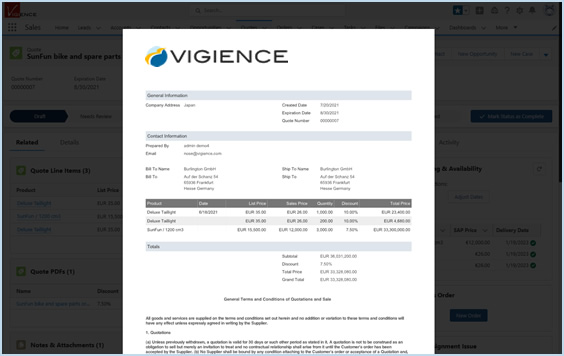
Faster, professional B2B quotes with reduced processing costs. Double-entry is eliminated while seamlessly handling complex SAP data like ATP and pricing.
SAP-integrated
Customer 360
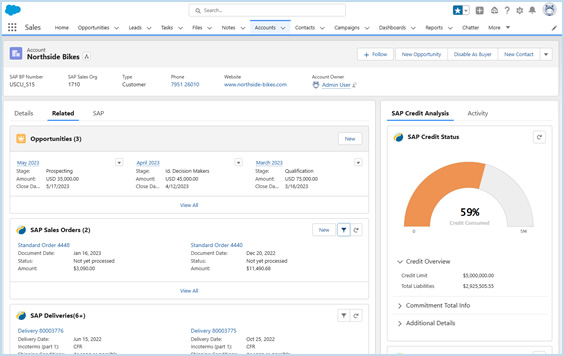
A complete 360° customer view with 24/7 self-service access to orders, invoices, and credit status.
SAP-integrated
Order Management
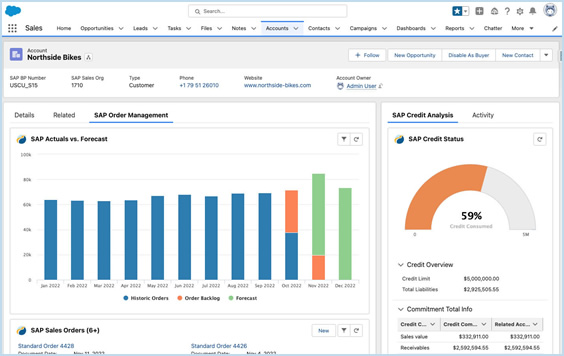
Increased on-time delivery and reduced processing costs through real-time order validation that eliminates double-entry.
Direct Contact
+1 (415) 226-9867
Vigience, Inc.

WATCH THE OVERCAST TEASER VIDEO
Social Media Channels


Compliance Certifications

Vigience Overcast is SAP certified
